







Introduction
Selecting lubricating materials, and friction pairs combinations is a relevant task both for manufacturers of pipeline fittings, and for many other enterprises. Friction is considered one of the main causes of equipment components failure and energy losses.
In order to test materials for friction and wear under controlled conditions, as well as to study the friction processes, the tribotechnical plants are used. They differ on the scheme of contact between the materials to be tested (the sample and the counterbody), friction type (rolling, sliding, rolling with sliding), movement nature, and other parameters.
At Modengy’s laboratory, the accelerated test for friction according to the Reichert method, on ASTM G99 Standard (see Fig. 1), on GOST ISO 16047 (tests for torque and pre-tightening force in threaded connections) are carried out.
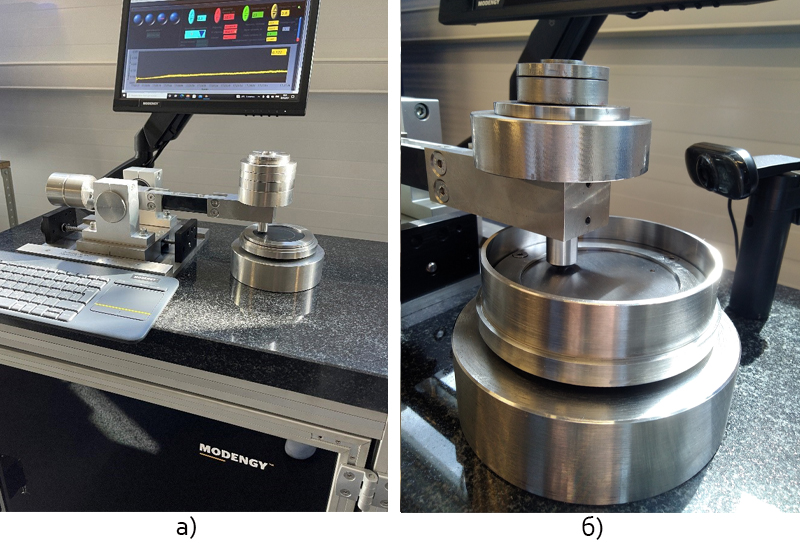
Fig. 1. Friction machine. General appearance and the block for testing according to ASTM G99 Standard
This is one of the most popular and universal standards that are traditionally used in the world practice to identify materials frictional interaction features.
Methodology and stages of testing lubricating materials
In order to identify anti-frictional and anti-scoring features of lubricating materials, integrated tests according to ASTM G99 Standard, and according to the Reichert method are held.
Holding the accelerated tribotechnical tests at the stages of designing the friction pairs, and selecting lubricating materials enables to
- Measure friction coefficient, and dynamics of its changing
- Detect wear resistance of the friction pair
- Study running-in ability characteristics
- Measure frictional heating temperature
- Reveal affection of various factors to tribological conjunction features
- Identify anti-wear and anti-frictional properties of the lubricating materials, to select optimal compound for certain operational conditions.
Tests according to ASTM G99 Standard are carried out on the ‘sphere-to-plane’ scheme (see Fig. 2), or on the ‘pin-to-plane’ one at sliding friction. These concentrated contact schemes enable to eliminate samples setup errors, decrease running-it period on the macrolevel, and results receiving time.
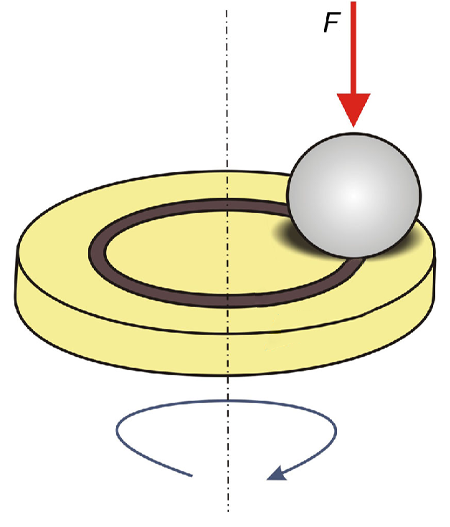
Fig. 2. Friction scheme at testing according to ASTM G99 Standard
The test bench installed in the Modengy’s laboratory is designed with participation of the leading experts on tribometry, certified at an accredited metrological center, and equipped with the data gathering automatic systems.
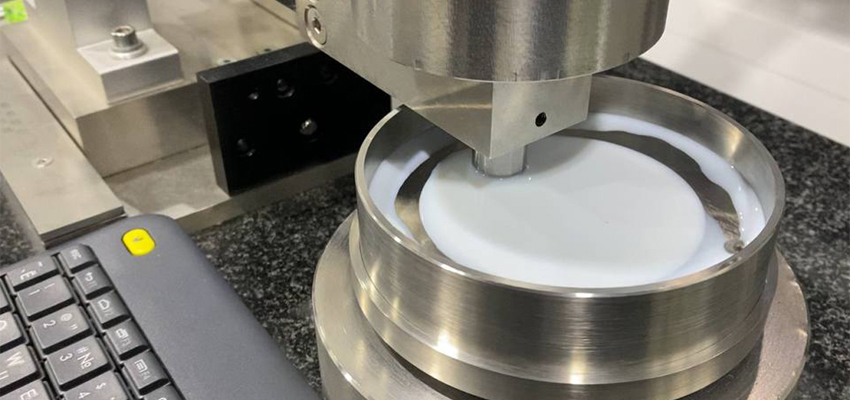
As a result of the tests according to ASTM G99, it is possible to gain data on friction coefficient dependence on the sliding speed, contact pressure, and involved lubricating material (see Fig. 3), to reveal critical transition points to the catastrophic wear types, to identify optimal operational modes of the friction pair, to forecast service lifetime of the friction units, to study frictional heating dynamics.
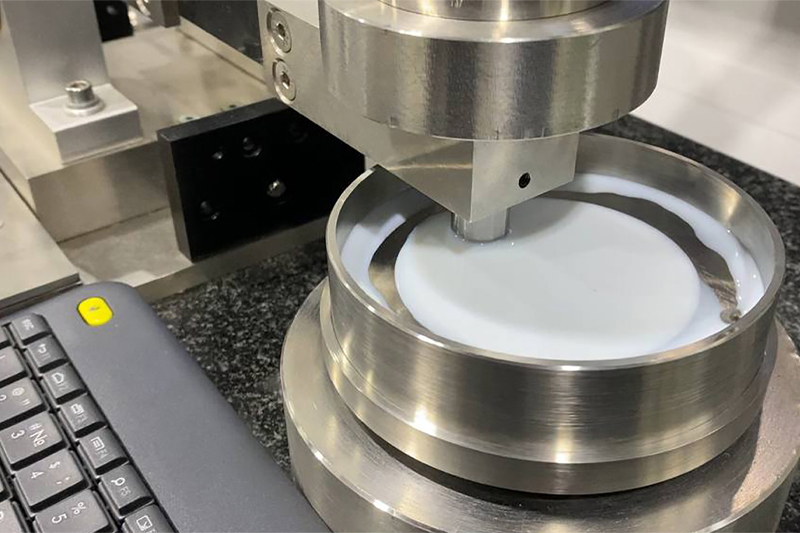
Fig. 3. Friction machine with the bowl for testing liquid lubricating materials
Tests according to the Reichert method (see Fig. 4) are intended to estimate anti-scoring and anti-wear properties of the lubricating and constructive materials. This test is especially relevant in the industry areas where the units operate under increased loads.
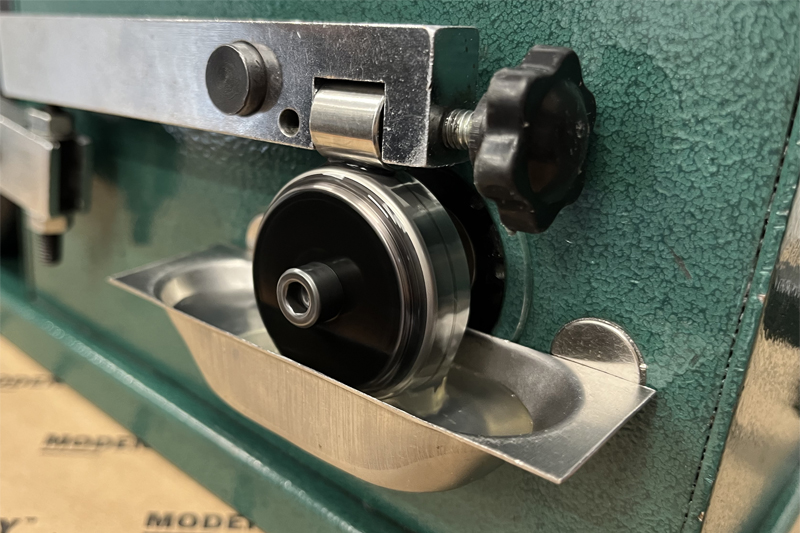
Fig. 4. The Reichert friction machine
The friction scheme includes a fixed roller, a rotating roller, and a loading lever (see Fig. 5).
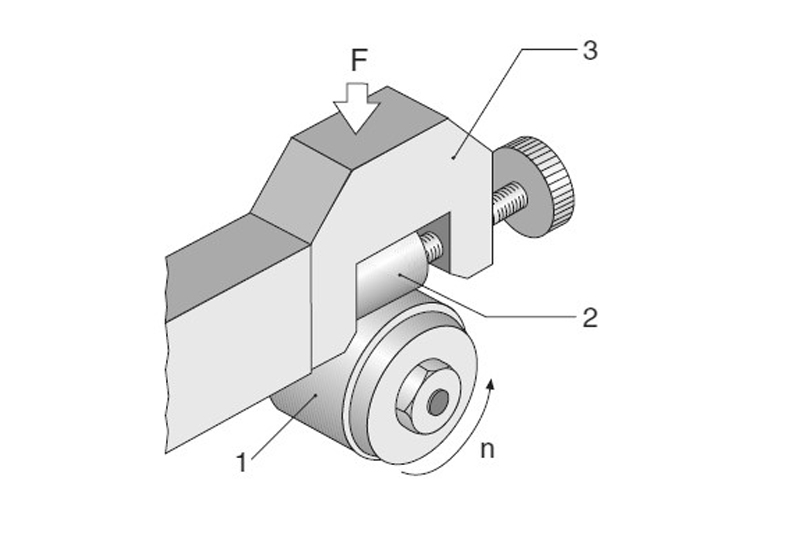
Fig. 5. The friction scheme at testing according to the Reichert method: 1 – a rotating roller; 2 – a fixed roller; 3 – a loading lever
Stages of testing for friction and wear
- Collecting data, and making technical specification
- Selecting the optimal technique to hold the tests, developing the experiment plan and technical documentation
- Carrying out the tests
- Analyzing the results, preparing report paperwork
- Transferring rights for the tests results to the customer, providing recommendations on optimizing the friction unit
Test protocols. What results can be obtained based on the experiments?
The conclusions made based on the tests results include comparing the tested samples on all possible parameters, drawing up comparative graphs, giving recommendation from the experts.
Let’s take as an example the conclusions from the Tests Protocol compiled after completing the tests to identify anti-frictional and anti-wear properties of the ‘NNN’ lubricating-and-coolant fluid (lubricoolant) in the form of 5% solution.
Seven samples of the lubricating-and-coolant fluids were involved in the integrated tests according to the Re ichert method, and to ASTM G99 Standard. The Sample No.8 was tested without any lubricating material (see Fig. 6).
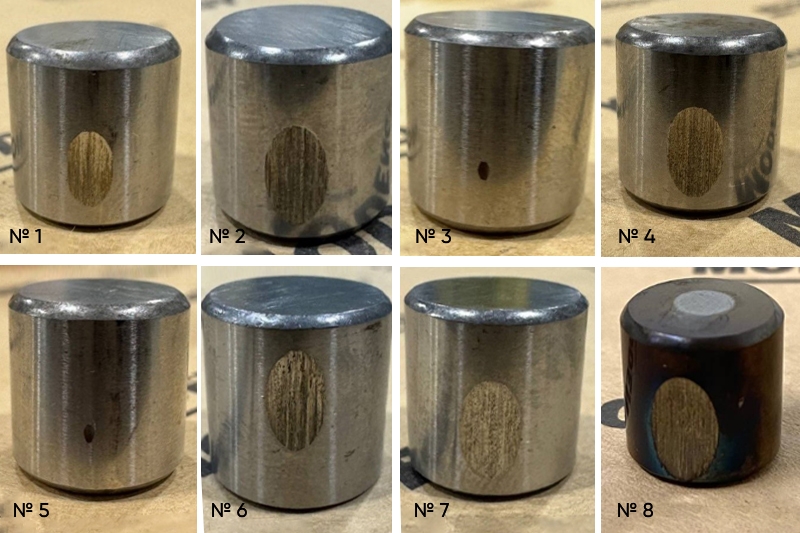
Fig. 6. The samples after the test at the Reichert friction machine
Conclusions about lubricoolant tests according to the Reichert Method
1. Based on the test results according to the Reichert Method, use of a lubricoolant enables to reduce wear intensity from by 1.8 times (Sample No.7) up to by 58 times (Samples No.3 / No.5).
2. The increase line in terms of wear intensity from left to right among the tested samples looks like this: [ No.3 → No.5 → No.1 → No.4 / No.6 → No.2 → No.7 ] → No.8.
3. Sample No.8 that was tested without any lubricoolant has gained temper colors (see Fig.3) what which indicates to significantly higher friction heating temperature. No such effects were detected on the samples that were tested using a lubricoolant.
Conclusions about lubricoolant tests according to ASTM G99 Standard
1. Based on the test results according to ASTM G99 Standard, use of a lubricoolant enables to reduce coefficient of static friction f0 from by 7.7 times (Sample No.3) up to by 20.2 times (Sample No.4).
2. Based on the test results, use of a lubricoolant enables to reduce average friction coefficient fav from by 5.5 times (Sample No.3) up to by 8.9 times (Sample No.7).
3. The increase line in terms of average friction coefficient fav from left to right among the tested samples looks like this: [No.7 → No.5 → No. 4 → No.6 → No.1 / No.2 → No.3] → No.8.
General Conclusions
1. Use of the samples of all these lubricoolants contributes to friction process stabilizing as this decreases spread of friction coefficient values, and eliminates stick-slip motion.
2. Sample No.5, according to the test results of the Reichert Method, and according to the test results on ASTM G99 Standard, has optimal linear wear and average friction coefficient values.
3. Sample No.3 has minimal wear (according to the Reichert Method), although, at the same time, average friction coefficient of this Sample has the highest value among all tested Samples. So, this factor can be used by a manufacturer at solving certain specific tasks.
4. Sample No.2 has ones of the highest wear and average friction coefficient values due to integrated assessment of the test results according to the Reichert Method, and to ASTM G99 Standard.
Source: Nikolaenko I. D., Melnikova V. E. Tribological testing of materials in the laboratory "Modenzhi". Forecasting the resource and energy efficiency of friction pairs. // Pipeline fittings and equipment. - 2025 - No. 1 (136). P. 10-11
03.03.2025
If holding of the tribotechnical tests is relevant for you, address to the Modengy company, please.
Request information