







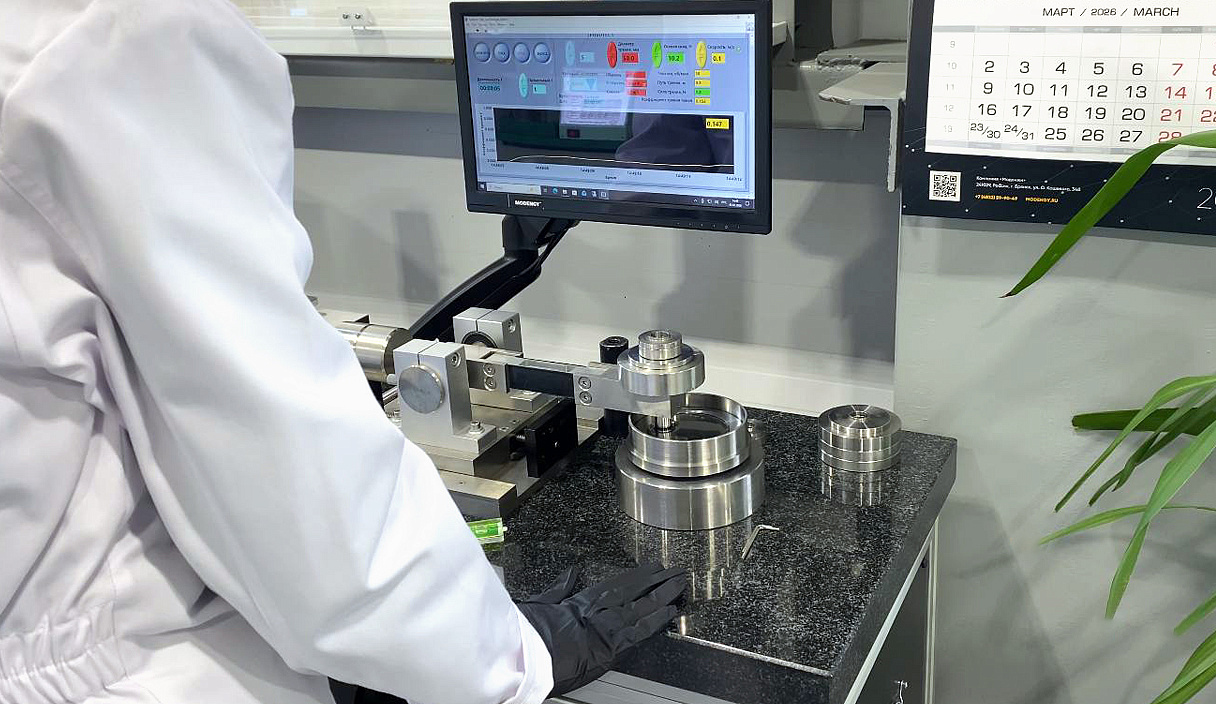
Report on tribotechnical tests
Detecting anti-friction and anti-scuffing properties of NNN lubricating coolant (LC) in form of 2% solution.
- Sample No.1 – Lubricoolant No.1
- Sample No.2 – Lubricoolant No.2
- Sample No.3 – Lubricoolant No.3
- Sample No.4 – Reference
Stages of work
1. Detecting anti-scuffing properties according to the Reichert method
2. Detecting anti-friction properties according to ASTM G99 standard
1. Detecting anti-scuffing properties according to the Reichert method
1.1. Description of the technique and the equipment
The tests are held according to the Reichert method (see Fig.1) traditionally used to detect anti-scuffing properties of the constructive, and lubricating materials. The scheme of friction during the tests are given on Fig.2. A steel roller 1 rotating with frequency n=320 revolutions per minute is pressed to a fixed steel roller 2 by using a lever 3 with ordinary force F.
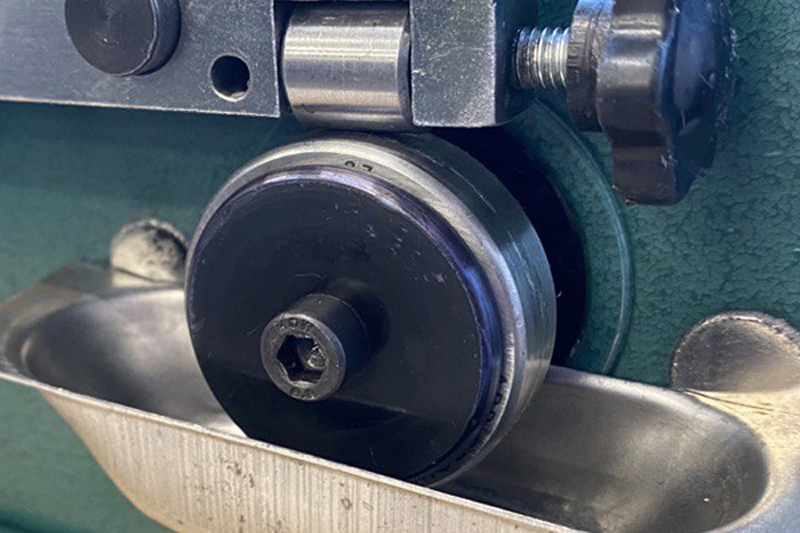
Fig.1. Reichert friction machine
Geometry of the friction pair: a sample in form of 40 mm diameter roller – a counterbody in the form of 14 mm diameter and 14 mm length roller, their axles are perpendicular.
- Materials of the friction pair: SHKH15 steel – SHKH15 steel
- Lubricating material: lubricating coolant, 2% solution / no lubricating material
- Lubricating method: by dipping
- Volume of the lubricating material in the reservoir: 17 ml
- Sliding velocity: V=0.67 m/s
- Load: F=121.4 N
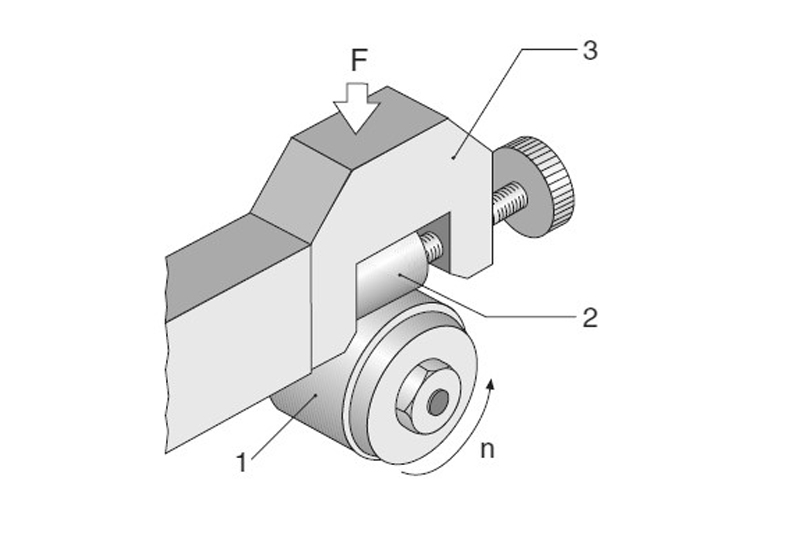
Fig.2. Friction scheme during the tests according to the Reichert Method: 1 – rotary roller; 2 – motionless roller; 3 – loading lever
According to the results of the tests, value of linear wear h on the fixed roller 2 is detected (see Fig.3), and value of linear wear intensity Ih as ratio of linear wear h to friction path L is calculated.
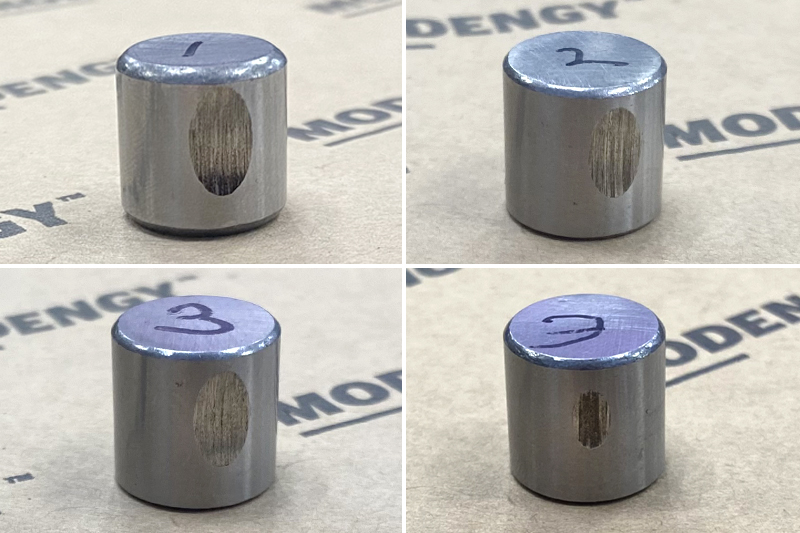
Fig.3. Appearance of the wear spot on the motionless roller
1.2. This Stage Results
The test results are presented in Table 1.
Table 1
|
Sample Number |
Lubricating Material Name |
Friction Path L, m |
Wear Spot Length l, µm |
Linear Wear h, µm |
Wear Intensity Ih |
|---|---|---|---|---|---|
|
1 |
Lubricoolant No.1 |
402 |
8651 |
473 |
1,18·10-6 |
|
2 |
Lubricoolant No. 2 |
402 |
8006 |
405 |
1,01·10-6 |
|
3 |
Lubricoolant No. 3 |
402 |
8252 |
430 |
1,07·10-6 |
|
4 |
Reference |
402 |
5403 |
183 |
5,56·10-7 |
|
5 |
No lubricoolant |
402 |
11400 |
639 |
1,59·10-6 |
2. Detecting anti-friction properties according to ASTM G99 Standard
2.1. Methodology and Equipment Description
The tests are held according to ASTM G99 Standard on the ‘sphere-to-disk’ scheme (see Fig.4) at slide friction. The method described in this Standard is used in international practice to identify friction and wear parameters.
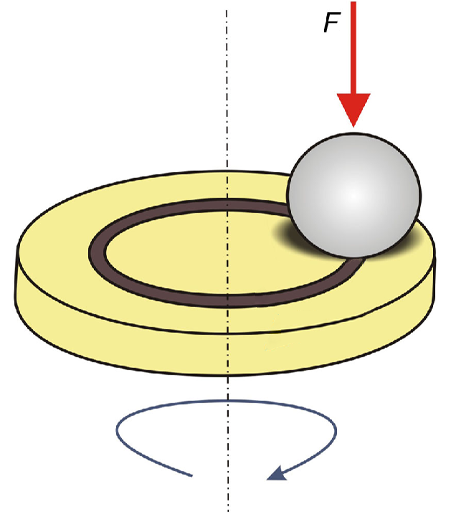
Fig.4. Friction scheme for the tests
Friction pair configuration: Ø6.35 mm diameter spherical indenter according to GOST 3722 - a sample in the form of Ø80 mm diameter and 0.8 mm thick disk.
- Spherical indenter material: ШХ15 steel according to GOST 801 Sample material: AISI 430 steel
- Lubricating material: lubricoolant No.1 / lubricoolant No.2 / lubricoolant No.3 / reference / no lubricating material
- Lubricating method: by dipping
- Lubricating material volume in the container: 17 ML
- Slide velocity: V=0.1 m/s
- Load: F=10.2 N
The tests are held on the friction machine (see Fig.5). The friction machine is equipped with NI LabVIEW automated control and data registering system.
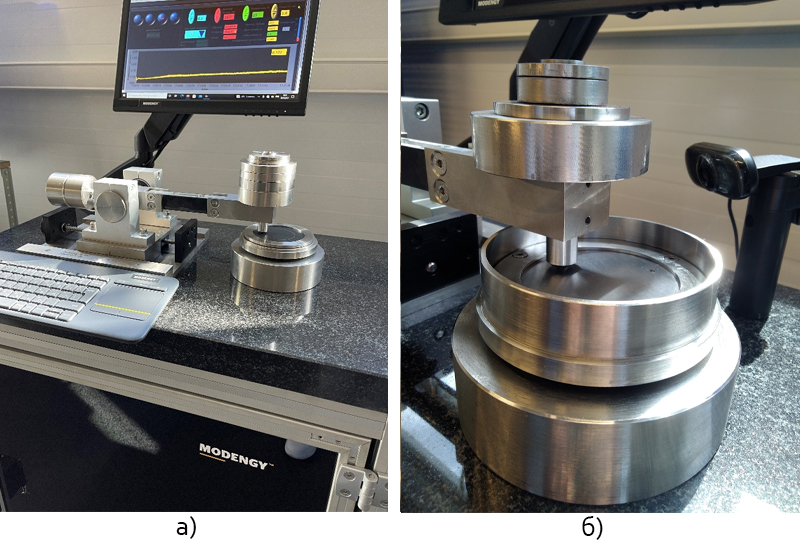
Fig.5. Friction machine (а – general appearance, b – the test unit with the set container for a liquid lubricating material)
The spherical indenter is set into a holder (see Fig.6), and is pressed to the sample in the form of a disk rotating at frequency n=38 rpm with the given force F. In process of testing sliding friction force values are kept registering continuously, and friction coefficient value is calculated automatically, and are being displayed on the screen in the form of graph.
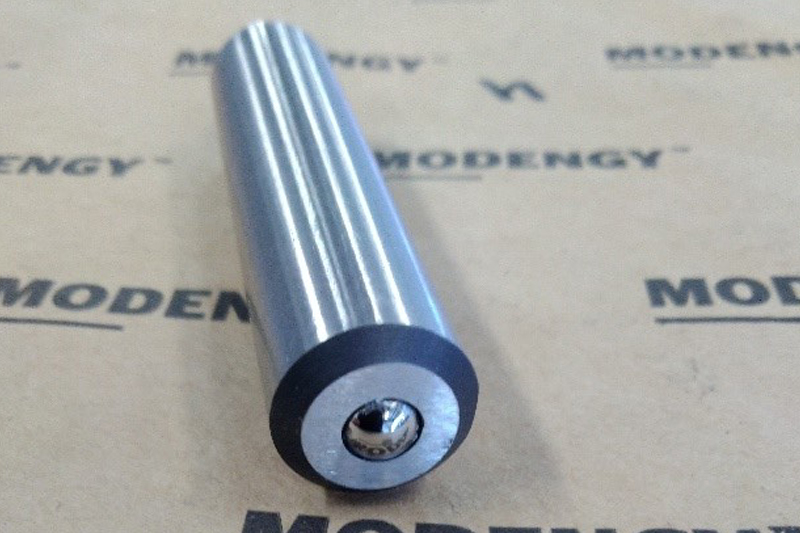
Fig.6. The holder with the spherical indenter set in it.
2.2. This Stage Results
The test results are presented in Table 2.
Table 2
|
Experiment Number |
Lubricating Material Name |
Friction Path L, m |
Coefficient of Static Friction, f0 |
Coefficient of Sliding Friction, fav average |
|---|---|---|---|---|
|
1 |
Lubricoolant No. 1 |
30 |
0,152 |
0,259 |
|
2 |
Lubricoolant No. 2 |
30 |
0,161 |
0,132 |
|
3 |
Lubricoolant No. 3 |
30 |
0,212 |
0,236 |
|
4 |
Reference |
30 |
0,213 |
0,244 |
|
5 |
No lubricoolant |
30 |
0,950 |
0,667 |
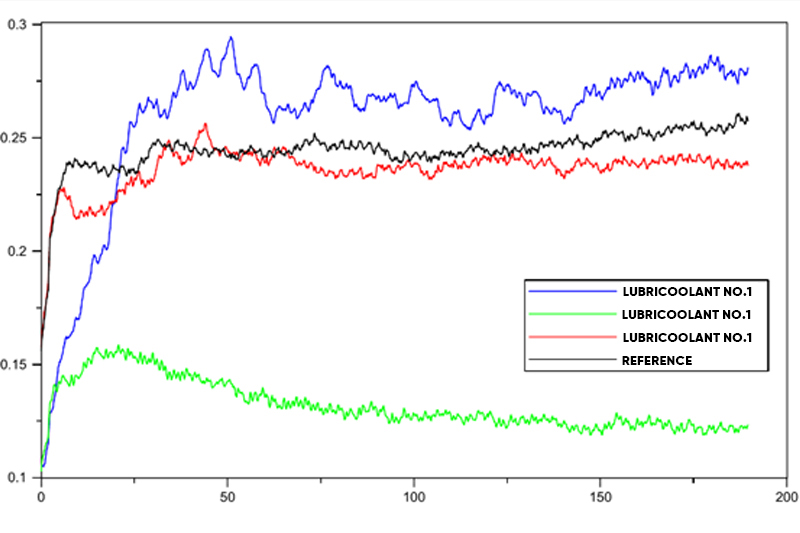
General graph of friction coefficients changing in process of the tests is presented in Appendix 1.
3. Conclusions
3.1. Conclusions about lubricoolant tests according to the Reichert Method
3.1.1. Based on the test results according to the Reichert Method, use of a lubricoolant enables to reduce wear intensity by 1.6 times (see Sample No.2) to 28 times (see Sample No.4);
3.1.2. The sequence of increasing wear intensity on the tested samples from left to right is following: [ No.4 → No.2 → No. 3 → No.1 ] → No.5;
3.1.3. Sample No.13 that was tested without any lubricoolant acquired temper colors (see Fig.3) which indicates a significantly higher frictional heating temperature. Such effects were not revealed on the samples that were tested with a lubricoolant involved.
3.2. Conclusions about lubricoolant tests according to ASTM G99 Standard
3.2.1. Based on the test results according to ASTM G99 Standard, use of a lubricoolant enables to reduce coefficient of static friction f0 by 4.4 times (see Sample No.4) to 6.3 times (see Sample No.1);
3.2.2. Based on the test results, use of a lubricoolant enables to reduce average friction coefficient fср by 2.6 times (see Sample No.1) to 5 times (see Sample No.2);
3.2.3. The sequence of increasing average friction coefficient fср on the tested samples from left to right is following: [ No.2 → No.3 → No.4 → No.1 ] → No.5.
3.3. General Conclusions
3.3.1. As a result of the tests according to the Reichert Method and to ASTM G99 Standard, Sample No.2 has intermediate values of linear wear, and minimum value of average friction coefficient.
3.3.2. Sample No.4 has the minimal index of wear (according to the Reichert Method), and at the same time, average friction coefficient of the given sample has one of the highest values in comparison with the other samples, so that this lubricoolant sample can be used by the manufacturer for solving specific tasks;
3.3.3. Sample No.1 has the highest indices of wear and average friction coefficient as a result of comprehensive estimation of the test results according to the Reichert Method and to ASTM G99 Standard.
Appendix 1
General graph of friction coefficient changing during performing the works at Stage 2.
If holding of the tribotechnical tests is relevant for you, address to the Modengy company, please.
Request information