







Report on tribotechnical tests
Tests Objective
Detecting the anti-wear properties of the lubricating-and-cooling liquid (lubricoolant) in the form of a 5% solution.
Sample No.1 – Lubricoolant No.1
Sample No.2 – Lubricoolant No.2
Sample No.3 – Lubricoolant No.3
Sample No.4 – Lubricoolant No.4
Sample No.5 – Lubricoolant No.5
Sample No.6 – without any lubricant
Detecting the anti-wear properties according to the Reichert method
1 Methodology and Equipment Description
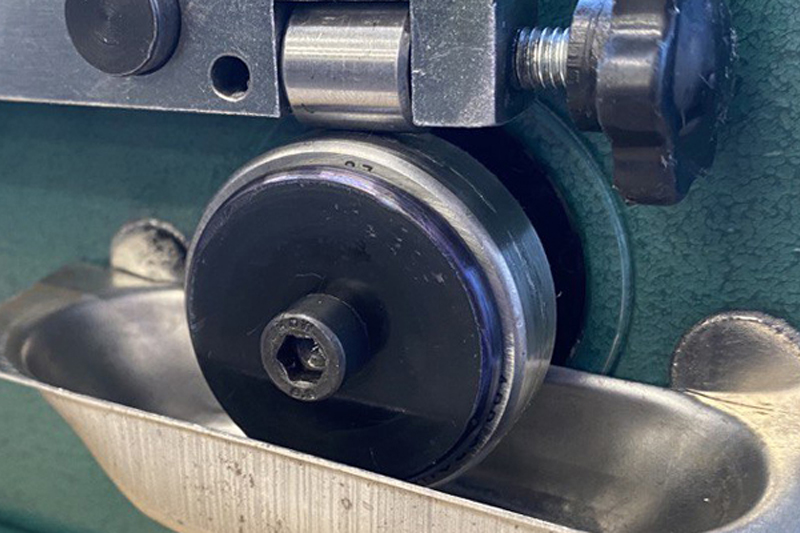
These tests were held according to the Reichert method (see Fig.1) that is traditionally used to detect anti-wear properties of the constructive and lubricating materials. The friction layout during these tests is presented on Fig. 2 The steel roller 1 rotating at frequency n=320 rpm is being pressed to the steel roller 2 by using the lever 3 with the standard force F.
Friction pair configuration: a sample in a form of Ø40 mm diameter roller – opposite element in a form of Ø14 mm diameter and 14 mm length roller, their axes are perpendicular
Friction pair materials: ШХ15 steel – ШХ15 steel
Lubricating materials: 5% solution lubricoolant / no lubricating material
Lubricating method: by dipping
Lubricating material volume in a 17 ml container
Slide velocity: V=0.67 m/s
Load: F=240.3 N
Based on the tests results, linear wear value h on the motionless roller 2 is determined (see Fig. 3), and linear wear intensity ln is calculated as the ratio of linear wear h to friction path L.
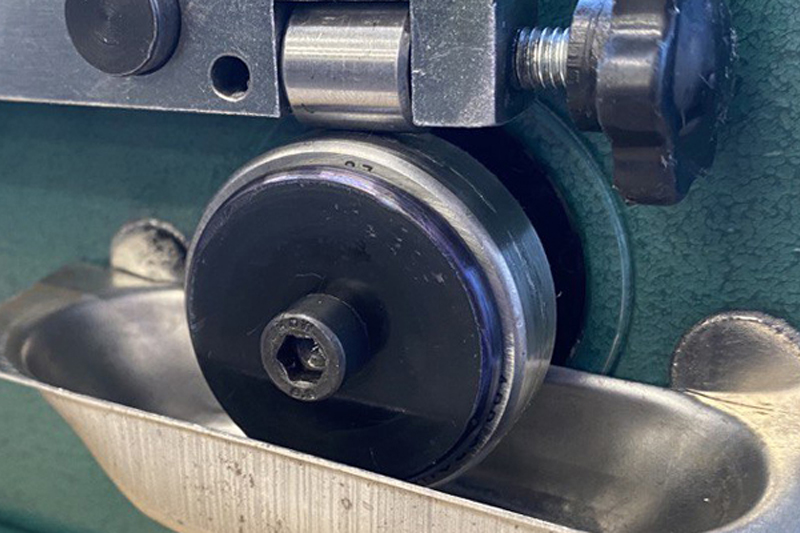
Fig. 1 The Reichert friction machine
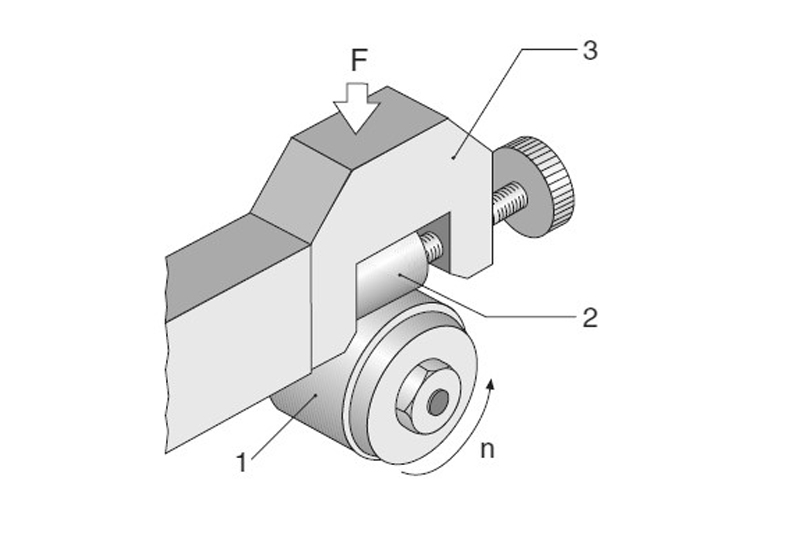
Fig. 2 Friction scheme at testing according to the Reichert method: 1 – rotary roller; 2 – motionless roller; 3 – loading lever
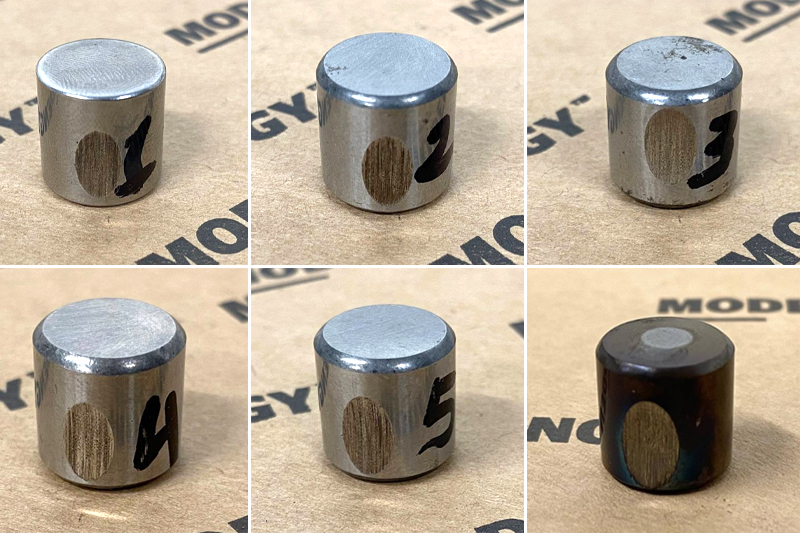
Fig. 3 Appearance of the wear spot on the motionless roller caused by 6 samples
2 The Tests Results
|
Sample Number |
Lubricating Material Name |
Friction Path L, m |
Linear Wear h, µm |
Wear Intensity ln |
|---|---|---|---|---|
|
1 |
Lubricoolant No.1 |
402 |
459 |
1,14·10-6 |
|
2 |
Lubricoolant No.2 |
402 |
487 |
1,21·10-6 |
|
3 |
Lubricoolant No.3 |
402 |
566 |
1,41·10-6 |
|
4 |
Lubricoolant No.4 |
402 |
439 |
1,09·10-6 |
|
5 |
Lubricoolant No.5 |
402 |
547 |
1,36·10-6 |
|
6 |
No lubriroolant |
402 |
639 |
1,59·10-6 |
3 General Conclusions
- Based on the tests results, use of a lubricoolant enables to reduce wear intensity from by 1.13 times (Sample No.3) to by 1.46 times (Sample No.4).
- All the rest sample of the lubricoolants (No.No.1, 2, and 5) occupy an intermediate position in terms of anti-wear properties.
- The increase line in terms of wear intensity from left to right among the tested samples looks like this: [No.4 → No.1 → No.2 → No.5 → No.3] → No.6.
- Sample No.6 that was tested without any lubricoolant used gained temper colors (see Fig.3) which indicates to higher friction heating temperature. No such effects were detected on the samples that were tested having been treated with a lubricoolant.
If holding tribological tests is topical for you, address to the Modengy company, please.
Request information