







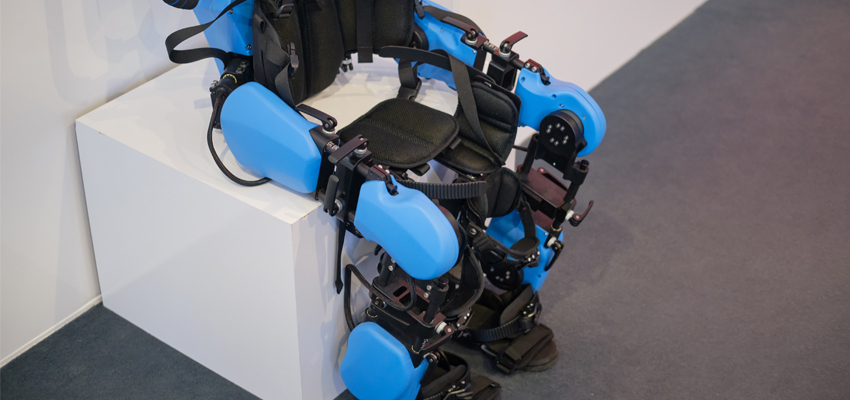
Exoskeleton. History
Just recently ‘the Iron Man’ has been the comics and fiction movies hero only. Nowadays, due to the advancedtechnologies in robotics, any of us can gain the superpowers. The conception of extending the human capacities has turned from a dream to reality, thanks to the developers of the exoskeletons – the devices intended to make up for the lost functions, to increase the human muscle force, and to widen the motion amplitude.
The first exoskeleton was produced by conjoint efforts of General Electric and BC of the USA in 1960-s. Theconstruction named Hardiman was a unit with a big handler, and an arm should be put into it to control it.
That handler could lift a load of 110 kg with the effort required for 4.5 kg. However, the motions of thatexoskeleton were beyond control because of its own weight (680 kg), and thus, it had no success.
The further researches were concentrated on one arm, however, its weight (750 kg) exceeded its lifting capacity (340 kg) by more than twice. So, the practical application of that construction was limited as well.
The ReWalk exoskeleton from ReWalk Robotics company became the most successful development. That unitimitated human biomechanics, and enabled the paralyzed persons to walk.
Exoskeletons Classification
The up-to-date exoskeletons make human beings faster, stronger, and more sensitive.
There are passive and active exoskeletons according to their energy source and operation principle. According tothe point of application (location), the skeletons are subdivided into those for the upper limbs and the lower limbs, as well as the whole-suit exoskeleton.
The constructions themselves can be light (up to 5 kg), medium (5 to 30 kg), and heavy (above 30 kg).
Depending on their purpose, military, medical, industrial, space exoskeletons are produced.
The main direction of the up-to-date developments is the military one – the exoskeletons exceed mobility andendurance of the infantry tactical units due to compensating high physical stress on the soldiers.
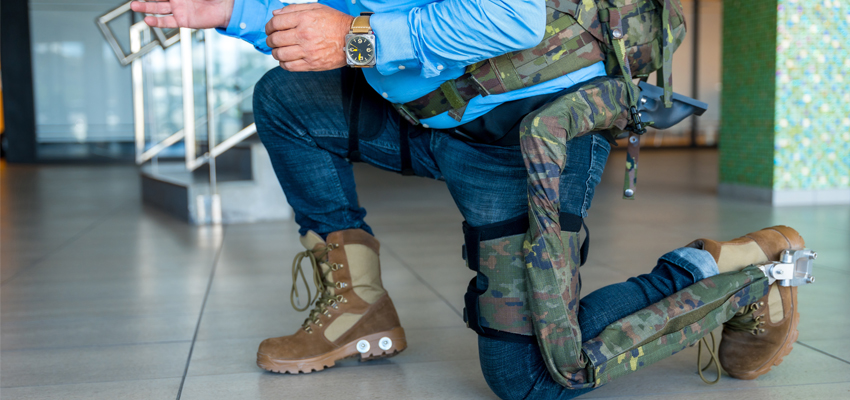
The exoskeletons integrated into military outfit are multifunctional system: in addition to their main mission, theyperform functions of an electric generator, accumulating batteries storage place, fastening frame for the armor protection modules, telecommunication means, sensors and controllers, radio signal transmit and receipt systems.
Some exoskeletons modifications are used during rescue operations to make the process of cleaning up theblockages of the collapsed buildings easier. At the same time, the construction protects a rescuer against the wrecks fall.
In the industry, the exoskeletons are used for weight lifting as well as to perform the other complex operations.
For example, the H-Lex device from Hyndai enables a human to lift easily up to 60 kg; a flexible and mobileChairless Chair exochair relieves muscle tension in case of longterm standing or static being in the half squatted position. The MAX SuitX exoskeleton for the loading workmen duplicates a human musculoskeletal system removing a part of the load off a human. The construction detects the operation starting moment automatically and turns on in the proper moment.
The medical exoskeletons are called to help the people who had no capability to walk since they were born, orlost it as a result of severe trauma, or because of their old age.
One of such models is produced by Honda company for three weight categories: small, medium (2.8 kg), and big.
The Hybrid Assistive Limb (HAL) constructions are very popular. There is HAL for legs or for arms-legs-trunk. Suchexoskeleton enables to lift the load which exceeds human capacities by 5 times. This device drives operate from the muscle impulses. The HAL can be used for the disabled and elderly people rehabilitation, as well as during the construction and rescue operations.
In our country, the ExoAtlet Project’s team of scientists engage in development of the medical exoskeletons. Theiritems are intended to rehabilitation, social adaptation and integration of the people with the motor malfunction of the lower limbs.
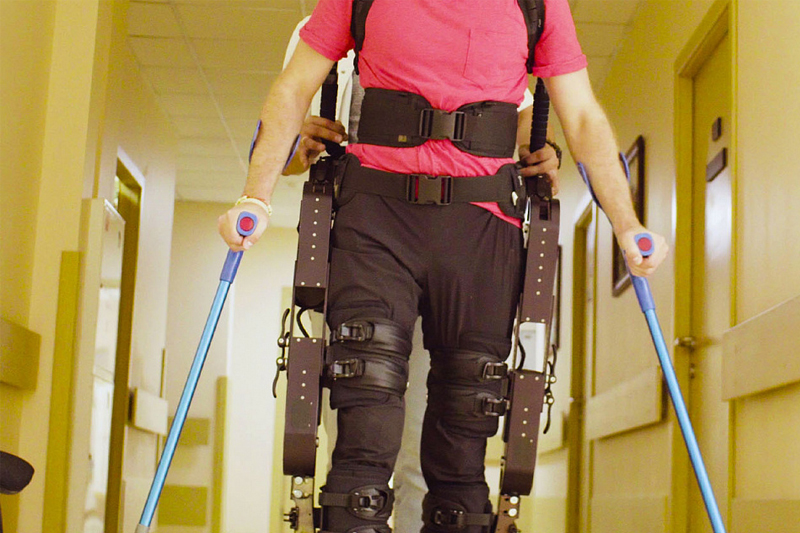
Image source: VE.Studio /www.shutterstock.com/ru
The developers declare that their exoskeletons will fit the people who have had spine traumas, and strokes. Atthe moment, several functional models have been created. The latest ExoAtlet Albert modification is controlled with the crutches allowing a person to walk by his own, sit down and stand up.
The issues the developers face?
Nowadays, the main obstacle to start producing the full of value exoskeletons is absence on such energy sourcesthat could enable the machine to operate independently for a long while.
The functional exoskeleton prototypes has been already built, however, their wide application is impossible. Forexample, the XOS exoskeleton from Sarcos company was developed based on the order from the army of the USA. The experts remark that the device is designed very successfully, however, even its demonstration had to be held in the mains power supply mode because of the absence of the accumulators with big enough volume.
Not less significant factors that limit usage of the exoskeletons are their high cost and complex maintenance.
The main problem is to provide an excellent technical state of the device for a longterm period without violatingthe hygienic requirements. It especially relates to the medical exoskeletons.
MODENGY solutions for exoskeletons
The constructions for the people with reduced mobility must be as reliable, ergonomic, and safe as possible.
The exoskeletons operation reliability depends on assembly quality, the materials and technologies used. Atdesigning, great attention is paid to the units that experience heavy loads, are subjected to friction and wear.
In the first place, these are the adjusting elements of the exoskeleton. The rectangular metal plates move withinthe special grooves of the skeleton's case. They are pulled together into required position with the pins through the openings.While operating of the exoskeleton, micro movements inevitably arise between the surfaces of the plates and thecase. As a result, the adjusting elements start squeaking, wear out fast, and get out of order.
To solve the issue of squeak and wear the adjusting plates are treated with a special solid-film coating. It isapplied as a thin layer (below 0.2 to 0.3 mm), and protects the contacting surfaces without being squeezed out by the load, and withstanding the multiple adjustments.
The Modeling & Engineering company releases such Anti-Friction Solid-Film Coatings (ASCs) in Russia. Atexoskeletons assembly MODENGY 1014 and MODENGY 1066 ASCs are used.
Both these coatings have molybdenum disulfide in their base - the substance with high load carrying capacity and low friction coefficient. In addition to МоS2, MODENGY 1014 includes polytetrafluorethylene (PTFE), and MODENGY 1066 - polarized graphite.
The mentioned ASCs cure at heating within 40 minutes. As soon as this material gets full polymerized, a strongand smooth protective layer is formed on the adjusting plate surfaces. Unlike the ordinary greases, this coating doesn’t soil nor gives toxic impact onto a human being.
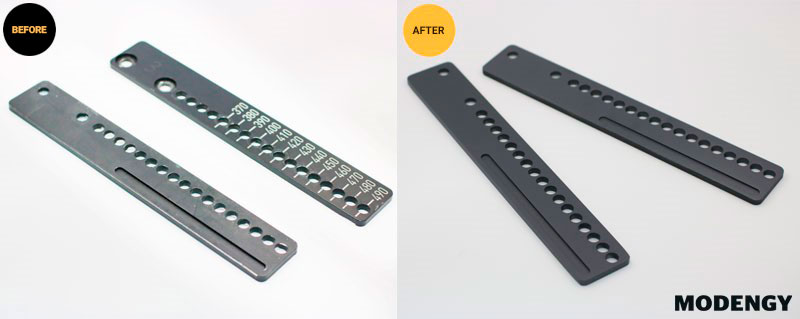
Thanks to using the ASC, no squeak arise at contact between the adjusting elements and the aluminum case,friction coefficient finds out to be the lowest possible, the parts gain reliable anti-corrosive protection.
So, MODENGY coatings solve one of the relevant challenges of the exoskeleton developers related tomaintenance of the devices. It's enough to apply them just once, and don’t require any further renewing which makes maintenance significantly easier, and improves the comfort level of the exoskeleton user.
For more detailed information, and to get a consultation, please contact our experts.
Request information