







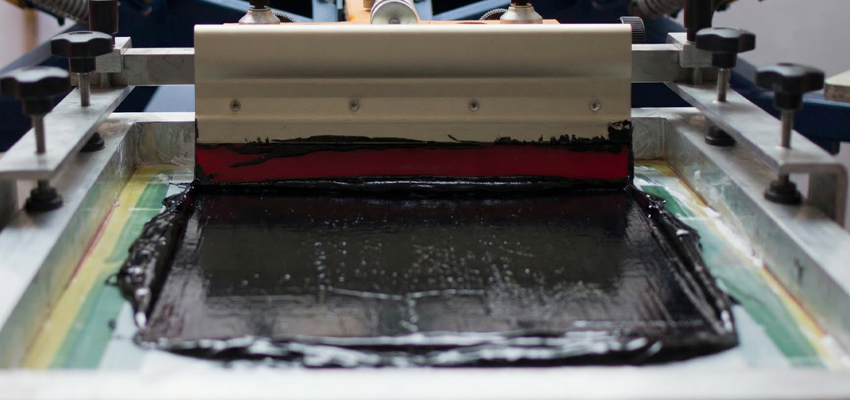
Screen printing: capabilities and advantages
Screen printing is a method of transferring a coating onto a substrate through a mesh stencil where the cells corresponding to the area to be printed are open, and the rest ones are blocked.
In engineering process, the screen printing method is used at series manufacture of pistons for internal combustion engines (ICEs).
The anti-friction solid-film coatings that accelerate running-in process, reduce risk of scoring at cold starting, and in the boundary lubrication mode are applied onto the piston skirts.
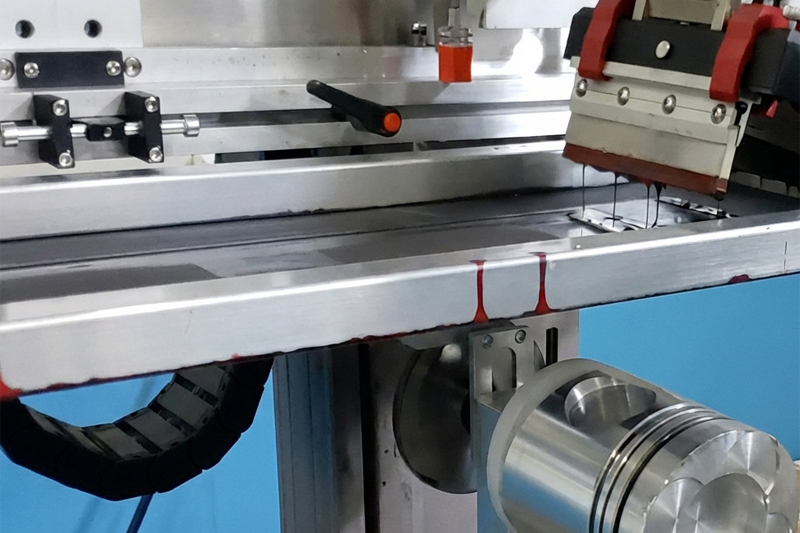
Fig. Screen printing on the ICE pistons. Applying MODENGY coating
Coatings applying is fulfilled on the screen printing machines that provide synchronization of piston rotation with movement of the squeegee pushing a paste-like anti-friction coating through the mesh stencil, as well as creation of a uniform layer of a given thickness on the stencil surface. This enables to form a controllable thickness layer on a cylindrical surface of the skirt.
Advantages of the screen printing method:
- Stable thickness of the layer from one batch to another, low percentage of defective items
- Reasonable coating consumption
- High productivity and cost-effectiveness at treating large batches of items
- Possibility to print on both flat and cylindrical surfaces
- Possibility to have visual and instrument coating quality control
However, this method also has some limitations: in the first place, this method is not suitable to treat large-size items, and in the second place, there are strict requirements towards a coating for applying by using a screen printing machine.
What are the features of the anti-friction coatings for screen printing?
It is possible to distinguish visually and immediately a coating intended for screen printing from the materials intended for applying by dipping or spraying out as it has higher viscosity in comparison with them.
The key parameter is the rheological profile of the coating. This material must have high structural viscosity at rest, reduce viscosity at shear load during pushing through the mesh, and restore its structure quickly after load removal.
This provides filling surface microroughnesses, and at the same time prevents runs and coating outline blurring on the piston skirt.
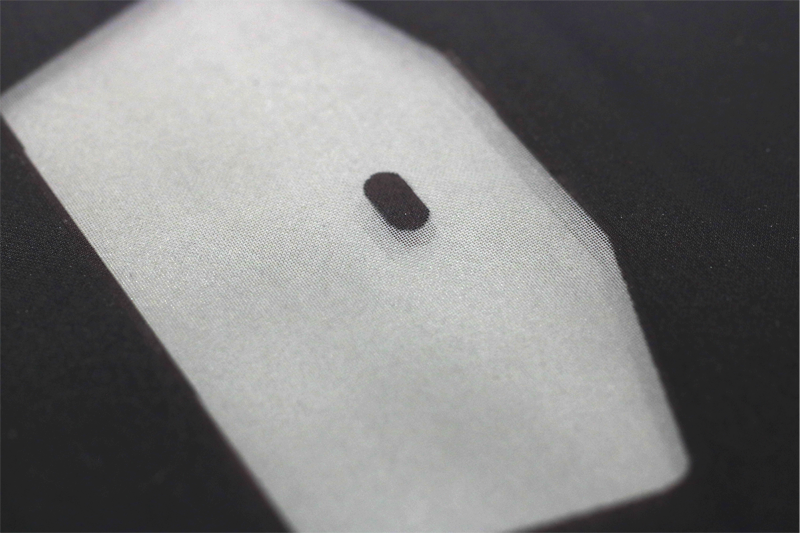
Fig. Stencil for applying an anti-friction coating onto the ICE piston skirt. The printing area remains open while the other cells are blocked
Selecting the coating for screen printing on the ICE pistons
The coatings for applying onto the screen printing lines from the MODENGY product line are made taking into account the requirements for series engineering manufacture, and distribute evenly all over the piston skirt surface if and when the engineering process is followed.
They are designed by the experienced experts who have all necessary competences and operational experience.
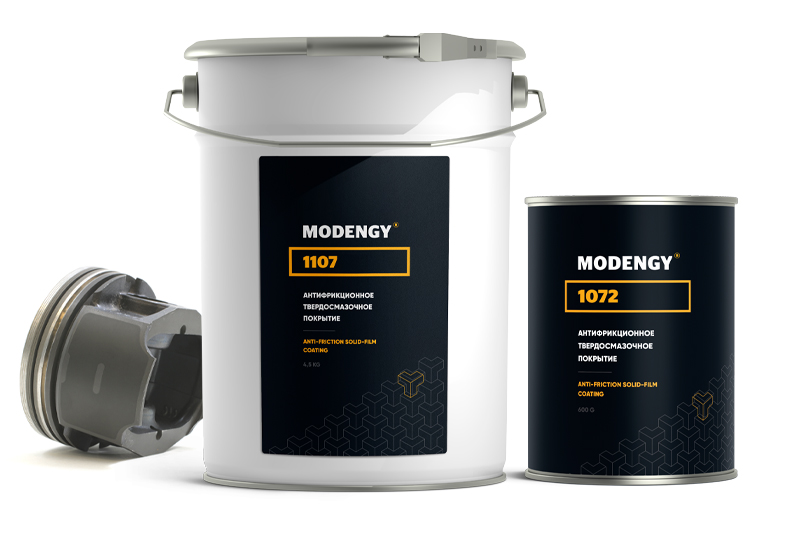
Fig. MODENGY coatings for the ICE pistons
MODENGY 1107 is standard for engine building. This is an anti-friction solid-film coating based on graphite that meets all the requirements of the motor factories.
It is used at mass output of pistons, and gets positive feedback from the leading Russian enterprises.
MODENGY 1107 performances and advantages are:
- Color: grey-and-black
- Optimal rheological properties for screen printing
- Low friction coefficient, especially under conditions of boundary lubrication
- Excellent adhesion
- Wide service temperatures range
- High wear resistance
Production of the high-power diesel engines treated with MODENGY 1107 coating has been launched in 2026. This product has passed full range of necessary laboratory and endurance tests, and confirmed its compliance with the requirements towards the coatings for operating under conditions of heavy loads, high temperatures, boundary friction typical for the modern high-power diesel engines.
The coating retains its operating abilities in contact with oils, gasoline, diesel fuel, does not destruct at long exposure to these media.
Besides the automotive engine pistons, MODENGY 1107 is used on piston skirts of compressors, pumps, pneumatic and hydraulic drives, marine engines.
The equipment of some screen printing lines, namely the mesh and the squeegee can be subjected to accelerated wear as a result of incompatibility with the solvents used in the anti-friction coatings composition. Release of MODENGY 1072, an ‘environmentally friendly’ version the coating that contains no substances aggressive for the accessory, has become the solution for this issue.
Due to the upgraded composition, equipment downtime is minimized, and need in frequent tool replacement is prevented.
MODENGY 1072 performances and advantages are:
- Color: grey-and-black
- It reduces friction coefficient in the boundary lubrication zone
- It improves smoothness of friction units operating, reduces noise and vibrations
- It has high chemical resistance
- It contains no aggressive substances, therefore, it has no negative impact on production accessories
In addition, MODENGY 1072 is characterized by a high proportion of non-volatile residue which provides decrease of coating consumption, and increase of financial viability from implementing it into mass manufacture of pistons.
MODENGY 1107 and MODENGY 1072 coatings for screen printing can be diluted with a solvent according to the engineering instructions for applying by the method of spraying out if necessary.
MODENGY 1078 is an anti-friction solid-film coating with addition of ceramic fillers that add increased hardness and wear resistance, high functionality in the boundary lubrication zone.
The ceramic components increase hardness and wear resistance of the polymer matrix which is especially relevant at operating under conditions of boundary lubrication, and in contact with solid aluminum alloys including Alusil used in making the modern engines cylinder blocks.
MODENGY 1078 performances and advantages are:
- Color: brown
- High wear resistance and long service term
- Reduction of friction coefficient in the boundary lubrication zone
- Compatibility with mineral and synthetic oils
- Low surface roughness
After getting cured, the coating interacts with an oil film in an optimal way reducing friction and preventing scores. The functional additives in the coating composition interact with the engine oil polar molecules, and thus, contributing to forming and holding an even oil film in the friction zone.
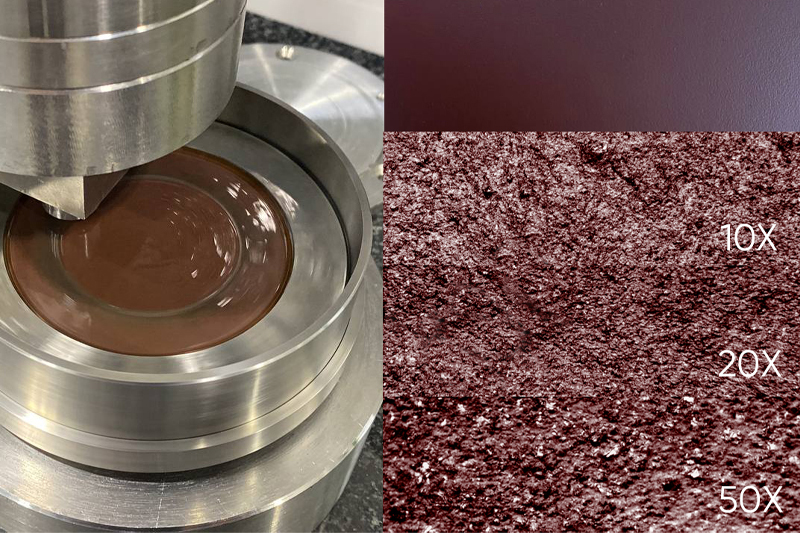
Fig. MODENGY coating containing ceramic fillers. On the left: process of tribotechnical tests with engine oil; on the right: the coating structure visible by microscope
Selecting an optimal coating is the key to long-term trouble-free engine operating. The MODENGY product line materials for applying onto the screen-printing lines are oriented to the real-life production processes and mechanical engineering tasks.
For more detailed information, please contact the Modengy company by clicking the button.
Request information