







Introduction
As the space equipment keeps developing, acute need to test anti-friction solid-film coatings in the rolling bearings arises. Exclusively grease lubricating materials were used before in such type supporting elements as they effectively reduce friction and wear under standard operational modes of the units.
However, the lubricating materials of the given types lose their operability on the outward side of the ISS as viscosity of the greases abruptly increases under conditions of low temperatures (-90 °С and below) which affects significantly the starting moment of the rolling bearings and efficiency of using them.
The solid-film coatings based on molybdenum disulfide (MoS2) demonstrate great results at operating under conditions of space, and they are widely used in the sliding friction units. However, no experiments have been held before at rolling friction.
The coatings from various manufacturers are used in the spacecraft sliding friction units including Russian MODENGY compounds.


MODENGY anti-friction solid-film coatings are the materials that provide solid dry lubrication of the surfaces. They form a composite layer of a film-forming material containing superfine particles of the solid lubricating substances on the surfaces.
They have proved their efficiency under extreme operational conditions such as high and cryogenic temperatures, deep vacuum, open space, radiation, exposure to aggressive media (such as acids, alkalis, organic solvents, etc.), and others where conventional lubricating materials cannot operate.
MODENGY anti-friction coatings properties and advantages:
- Low friction coefficient (from 0.03)
- Small layer thickness (20 µm)
- High load-carrying capacity
- Operability in dusty environments
- Long service term, realization of lifetime lubrication of the equipment units
- Wide service temperature range (-210 °С up to +730 °С)
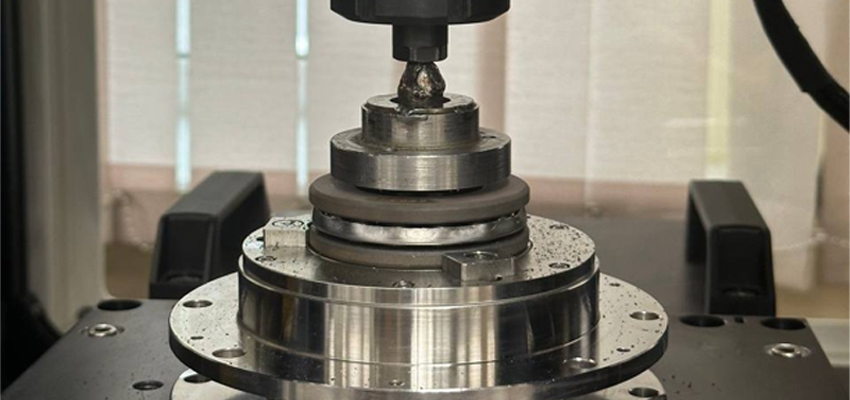
To evaluate the possibility of using MODENGY anti-friction solid-film coatings in the rolling bearings, tribotechnical tests at the rate of 2.25 m/s on MF-5000 (Rtec) tribometer were held.
The researches were held with the assistance of the Russian Scientific Fund on Project No.22-49-02010 titled Designing, Developing, Theoretical and Experimental Researches of ‘Smart’ Tribological Coatings for Space Application.
The research results have been presented for the first time at the Tribology To Mechanical Engineering – 2024 international scientific and technical Conference, and described in it scientific papers collection.
Tribotechnical tests of MODENGY coatings in rolling bearings
For these studies were used: the samples treated with MODENGY 1006 that has polyamide-imide film-forming agent, molybdenum disulfide, graphite, mixture of organic solvents, and functional additives in its composition, and those treated with MODENGY 1071 based on polytetrafluorethylene, molybdenum disulfide, polyamide-imide film-forming agent, mixtures of organic solvents, and functional additives.
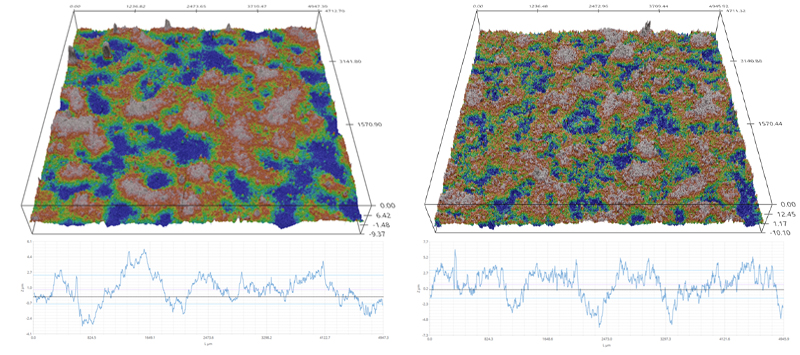
Fig. 3D typography picture of the initial surface of the samples treated with MODENGY 1071 (on the left), and of the samples treated with MODENGY 1006 (on the right). Average deviation of the midline Sa = 0.39 µm (MODENGY 1071), and 0.86 µm (MODENGY 1006). Maximal surface roughness height Sz = 12.4 µm (MODENGY 1071), and 27.6 µm (MODENGY 1006).
The coatings had been applied onto the disks made of bearing chilled steel as well as on the thrust bearing steel rings of two sizes.
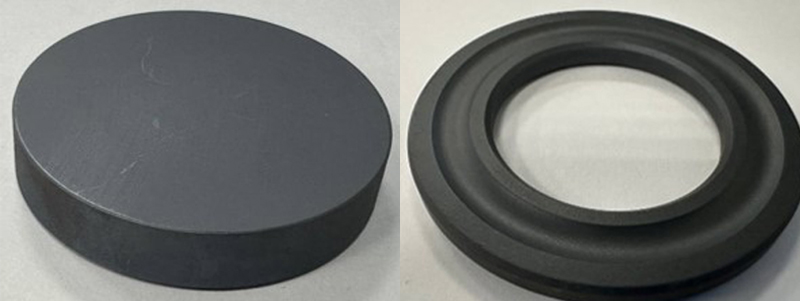
Fig. The samples of the disk and the thrust bearing ring treated with MODENGY coatings
The mating parts of the thrust bearings, and the steel disks were used as counter bodies, the ready-fitted sets of steel balls were used to create rolling.
The tribological studies were held on the MF-5000 laboratory tribometer (Rtec, USA) at constant rotary velocity V = 2.25 m/s (1,000 and 800 revolutions per minute for the small, and the big rings, respectively), and at constant force F = 1000 N. The experimental study was done under room conditions at T = 23 °С and 50% relative humidity. The tests lasted exactly 1 hour.
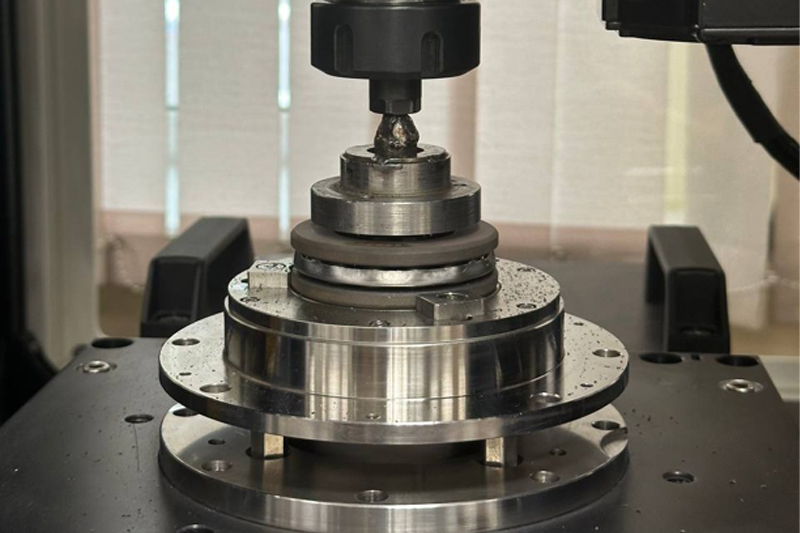
Fig. MFT-5000 laboratory tribometer
The lower ring with metal balls in the separator was fixed motionless on the sample stage. The upper sample was fixed on the self-aligning holder that was rotating clockwise. The load to the contact pair was transmitting through the holder which the upper sample was set on.
The experimental studies were carried out in seven variants:
- 1. In absence of any lubricating material in the contact zone
- 2. In presence of the grease recommended to be used on the outward side of the ISS
- 3. In presence of the lithium high-temperature grease in the contact zone
- 4. The upper steel disk is treated with the coating while the lower small ring has no lubrication
- 5. The upper steel disk is without any coating while the lower small ring is treated with the coating
- 6. The steel disk and the thrust ring are both treated with the coating
- 7. Two thrust bearing rings are treated with the coating
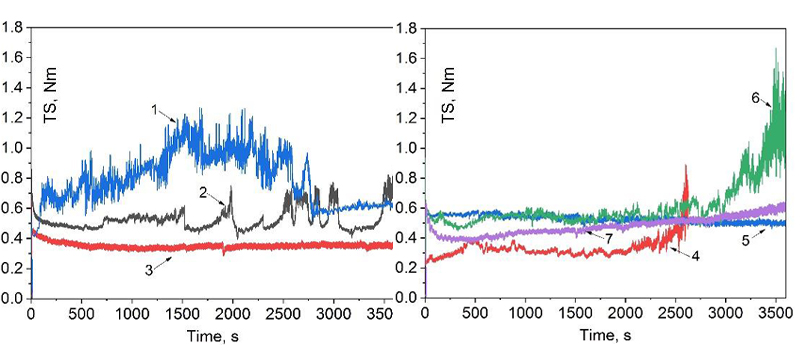
Fig. Rolling resistance relation on the test time where the numbers indicate the experiment variants, respectively
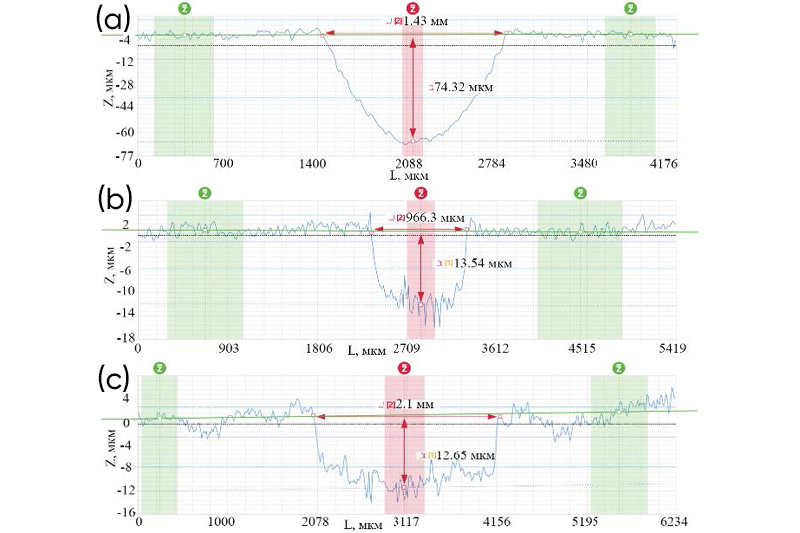
Fig. The profiles of the worn surfaces after testing, according to Scheme 1 (а), to Scheme 2 (b), and to Scheme 4 (c)
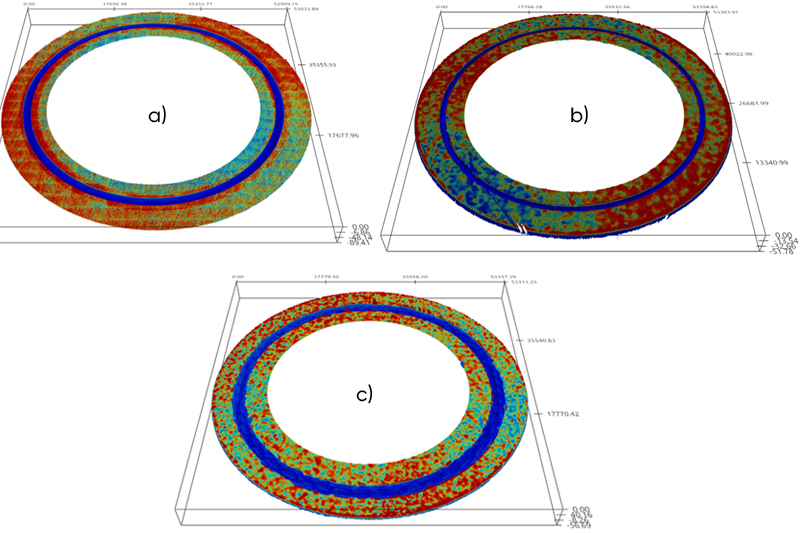
Fig. The profiles of the worn surfaces: а) no lubrication; b) the disk treated with a solid-film coating; c) the disk and the ring treated with solid-film coating
On the Figure, the profiles of the worn surfaces for the samples in the form of disks are presented. Here are the wear rates for the given samples that were calculated:
(а) Ia = 1.17·10-7 mm3/Nm; (b) Iб = 2.3·10-7 mm3/Nm; (c) Iв = 4.68·10-7 mm3/Nm; and according to the formula (2): (а) Ia = 1.17·10-4 mm3/m; (b) Iб = 2.3·10-4 mm3/m; (c) Iв = 4.68·10-4 mm3/m.
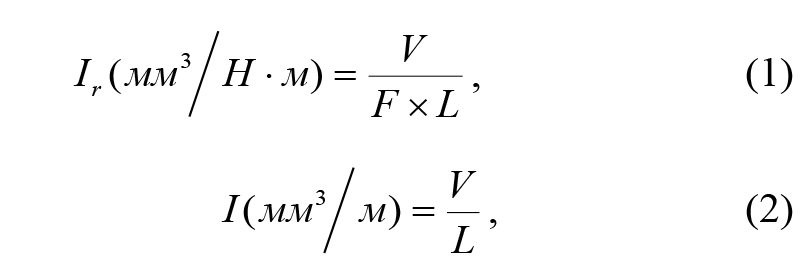
Fig. The formulas to calculate wear rate of the samples in the form of disks
Wearing intensity of MODENGY coatings in the rolling friction units stays on the level typical for the slide modes of the solid-film coatings used at the space stations.
According to the held studies results, MODENGY coatings effectively operate in the rolling friction units under land conditions.
The rolling resistance data in presence of solid-film coatings do not exceed the values obtained at rolling friction with using the lubricant recommended to be used on the outward side of the ISS.
Wearing intensity of the rolling bearings treated with MODENGY coatings corresponds to wearing intensity of the sliding bearings treated with the coatings widely approved for spacecraft applications.
More than that, MODENGY solid-film coatings exclude the drawback of the greases in the part of their non-operability at low temperatures. At low temperatures, the greases experience abrupt increase in viscosity which affects the starting moment of the rolling bearings in a negative way, and limits possibility to use them on the outward side of the ISS. Instead of that, the solid-film coatings retain their tribological properties even at the extremely low temperatures.
The next stage of researching efficiency of MODENGY coatings for rolling friction units of the space equipment (such as satellites, spacecrafts, lunar rovers, space telescopes, etc.) will be tests under condition of vacuum.
Bibliography:
Bronovets M., Bukovskiy P. Solid-Film Coatings for Rolling Bearings // Tribology to Mechanical Engineering: Works for the 15th International Scientific and Technical Conference, pp.26-28. Moscow: MSI RSA, 2024
For more details, address the Modengy company, please.