







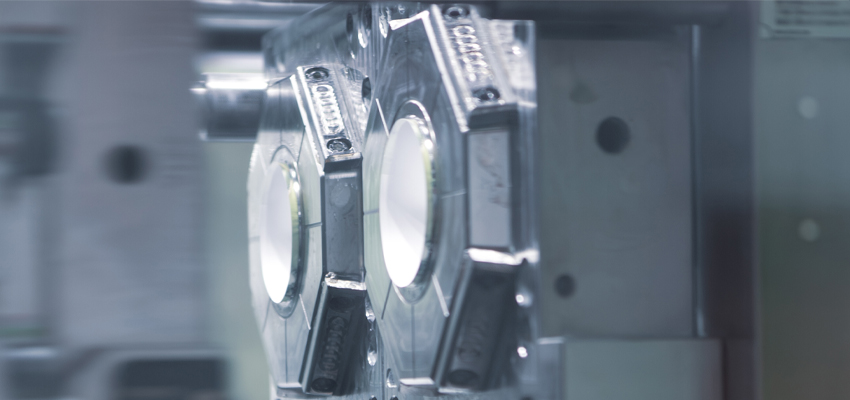
Molds structure and purpose
Molds are the matrices enabling to give a required configuration to melted polymer materials. They are used at mass production of the various plastic packages, shoe items, and other products.
Operation principle of such equipment includes filling the molding container with high temperature viscous polymer substance. As it getting cold, it ‘memorizes’ the given shape, and after taking it out you get a finished polymer item.
The molds are mostly made of metal, and consist of two plates with the cutouts exactly replicating the future item shape. Pushers and slide guideways are used to provide their operating.
Molds operation issues
The melted polymer material is sticking onto and forming deposits on the metal parts in process of casting.
As a result, the processing line operators face such issues as:
- Difficulties with taking the finished items out of the mold
- Increasing number of defective products, recycling costs
- Time costs for cleaning the equipment from the stuck material
- Financial losses for the processing line downtimes
Operating under hard conditions, the matrices are subjected to significant wear. This leads to the recurrent need in parts repairing.
The damages are fixed by using special micro welding apparatuses at the specialty centers.
The slide guideways and pushers of the molds operate at high loads and temperatures. In process of functioning, the metal parts are subjected to seizures, scuffing and other damages are formed on them leading to need in repairs or equipment replacement.
In order to improve productivity of the molds, such conventional materials as oils and greases are usually used. However, they burn out fast, require constant renewing, leave traces on the finished items.
What does use of MODENGY coatings gives?
Anti-friction solid-film coating MODENGY 1005 is applied onto the molds slide guideways. It creates a resistant separating layer on the parts surfaces having high antiscuffing and anti-corrosive properties.
Due to this, low friction coefficient between the mated parts is provided, and their service lifetime extends.
MODENGY 1007 anti-adhesive product is applied onto the molds for polymer items making. Its thin smooth layer prevents viscous substance sticking to the equipment elements, and makes process of taking the finished items out easier.
As a result, productivity of the processing line improves significantly, time and financial costs for the maintaining, cleaning up, and repairing accessories.
For the equipment operating at the temperatures up to +130 °С, MODENGY PTFE-A20 coating is used. Its advantages are aerosol package, and curing at room temperature which enables to apply it under conditions of production. Translucent colour of the product doesn’t spoil the molds appearance.
Distinctive features of the anti-friction solid-film coatings:
- Long service lifetime – single applying of the product provides stable functioning of the equipment during the entire term of its operating
- Dry texture – these agents leave no traces on the finished items
- Necessity of polymerization in kiln (for MODENGY 1005 and MODENGY 1007)
- Thin layer (15 to 25 µm) not preventing heat exchange
- Wide service temperature range
- Resistance towards cleaning agents, and mechanical impacts
Due to use of MODENGY anti-friction solid-film coatings, trouble-free operation of the line on molding polymers is provided, quality of the produced goods improves, and risk of the equipment damage is prevented.
The Modengy company provides the service on applying its products at the MODENGY Engineering Center located in Bryansk town.
For more detailed information, and consultation on solving the tasks related to reducing friction and wear contact the Modengy company, please
Request information